Most companies know that manual IT onboarding is slow. Fewer have done the math on exactly how much it costs.
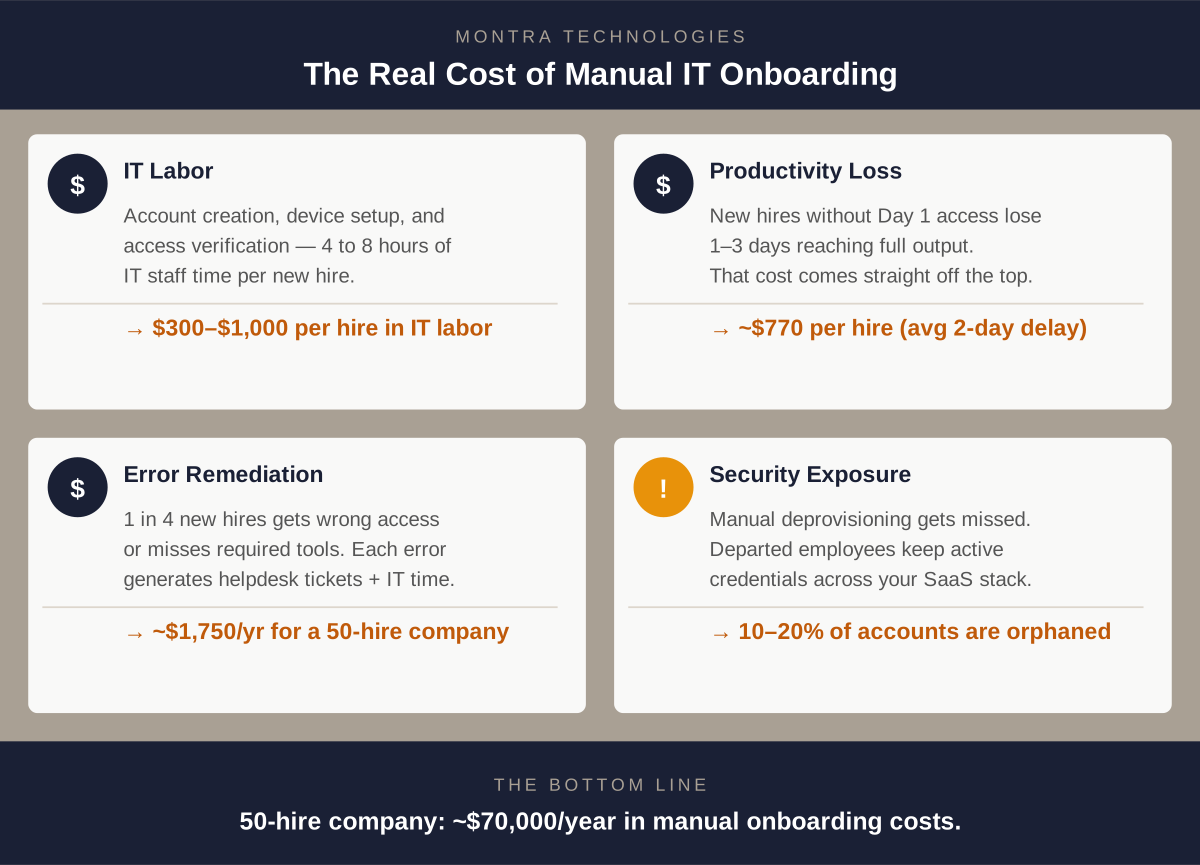
The direct labor cost of an IT administrator spending 4 to 8 hours per new hire creating accounts, ordering devices, and setting up access is visible and measurable. But it's probably the smallest part of the real number. When you add up lost new-hire productivity, error remediation, helpdesk ticket volume, and the security exposure from accounts that don't get configured correctly, the true cost of manual IT onboarding is often two to three times higher than the IT labor line alone.
This post walks through that math. We'll cover each cost category, give you benchmarks to work with, and show you what a realistic automation ROI looks like for a growing company.
The Direct Cost: IT Labor per Hire
Let's start with what's easy to quantify.
A complete manual IT onboarding — account creation across all business applications, device ordering and configuration, identity provider setup, license assignment, and access verification — takes an experienced IT administrator 4 to 8 hours per new hire under normal conditions. In a hiring surge, when multiple onboardings are running simultaneously, the number often rises because task-switching and batching reduce efficiency.
Using a fully-loaded IT staff cost of $75 to $125 per hour (salary plus benefits, overhead, and tools), the math looks like this:
- At 4 hours / $75/hr: $300 per hire
- At 6 hours / $100/hr: $600 per hire
- At 8 hours / $125/hr: $1,000 per hire
For a company hiring 50 people per year at the midpoint, that's $30,000 in direct IT labor on new hire setup — before anything goes wrong.
The Indirect Cost: Lost New-Hire Productivity
This is where the number gets significantly larger, and where most companies have no estimate at all.
When a new employee cannot access the systems they need on Day 1, they are not productive. They sit in orientation. They shadow a colleague. They set up their desk. Some of them — especially technical hires who expected to hit the ground running — have a negative first impression that affects their engagement.
Research on new hire time-to-productivity consistently shows that incomplete system access on Day 1 delays full productivity by one to three days, depending on the role. For a knowledge worker earning $80,000 per year (roughly $385/day in compensation cost), a two-day delay in productivity costs the company approximately $770 per hire — not counting the cost of the colleague whose time was consumed helping them navigate their first week.
For a company hiring 50 people per year, that's another $38,500 in productivity loss, on top of the IT labor cost.
The Error Cost: Fixing What Was Configured Wrong
Manual provisioning has an error rate. The wrong application template gets applied. The wrong security group gets assigned. A license for a required application doesn't get added until someone asks for it two weeks in.
Each error creates a helpdesk ticket. Each ticket takes IT time to diagnose and resolve — typically 30 to 90 minutes per ticket. In studies of IT onboarding processes at mid-market companies, between 20 and 35 percent of new hires generate at least one access-related helpdesk ticket in their first two weeks, with an average of 1.4 tickets per affected hire.
For a company hiring 50 people per year with a 25% error rate and 1.4 average tickets at 60 minutes each:
- 50 hires × 25% error rate = 12.5 affected hires
- 12.5 × 1.4 tickets = 17.5 tickets
- 17.5 × 1 hour × $100/hr = $1,750 in remediation labor
That's smaller in absolute terms, but it also doesn't count the cost to the new hire themselves — the frustration, the time lost waiting for the fix, and the signal it sends about how the company operates.
The Security Cost: Accounts That Shouldn't Exist
Here's the cost category that is hardest to quantify and potentially most expensive.
Manual IT provisioning fails at the end of the employee lifecycle just as reliably as it does at the beginning. When someone leaves — whether voluntarily or through a reduction in force — deprovisioning their access requires the same manual steps as provisioning it. Under the pressure of an active transition, those steps frequently get missed or delayed.
The industry benchmark: orphaned accounts (active credentials belonging to departed employees) affect approximately 10 to 20 percent of SaaS application instances at companies without automated deprovisioning. For a company with 80 SaaS applications and 200 employees with 15% annual attrition, that's potentially 30 departures per year with incomplete deprovisioning — and each orphaned account represents an active attack surface.
The cost of a security incident attributable to orphaned credentials varies widely, but the IBM Cost of a Data Breach report consistently puts the average breach cost for companies under 1,000 employees at $3M to $5M when fully loaded (investigation, remediation, regulatory, reputational). Even if the probability of an incident from orphaned accounts is low in any given year, the expected cost is not.
For compliance purposes, the cost is more concrete: HIPAA fines for access control violations range from $100 to $50,000 per violation, depending on the level of negligence. SOC 2 findings related to access provisioning and deprovisioning have derailed audits and client relationships.
The Full Picture: What Manual Onboarding Actually Costs
Pulling together the quantifiable costs for a company hiring 50 people per year:
| Cost Category | Annual Estimate |
| Direct IT labor (6 hrs × $100 × 50 hires) | $30,000 |
| Lost New-hire Productivity (2 days × $385 × 50 hires) | $38,500 |
| Error Remediation (help desk tickets) | $1,750 |
| Total Quantifiable Cost | $70,250 |
And that's before any security incident — which, if it happens, would dwarf all of the above.
The Automation Math: What Changes and by How Much
Automated IT onboarding — triggered by your HRIS, executed by a connected IT platform — reduces each of these cost categories differently.
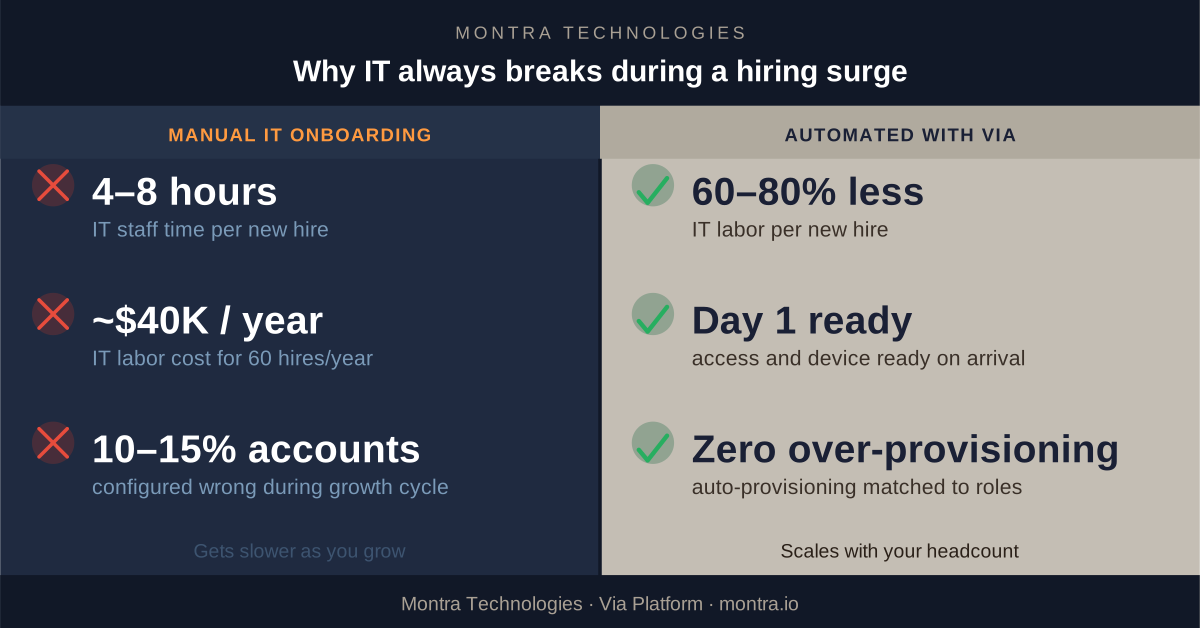
IT Labor: Automation handles account provisioning, license assignment, identity configuration, and device queuing automatically, with no IT administrator manually executing steps. IT review time drops to exceptions only. Typical labor reduction: 65 to 80 percent per hire.
New-hire productivity loss: When provisioning happens automatically at the moment of hire record creation, access is ready before the employee's first day. Productivity loss from access delays drops to near zero. Devices ship on schedule because the order is placed automatically. Typical improvement: 80 to 90 percent reduction in Day 1 access issues.
Error Rate: Role-based access templates, enforced by a system rather than recalled by a person, eliminate the most common class of provisioning errors. Typical error rate reduction: 70 to 85 percent.
Deprovisioning: Automated deprovisioning, triggered by HRIS termination events, closes accounts immediately and consistently — not when someone remembers to do it. Orphaned account exposure drops to near zero for connected applications.
Applied to the same 50-hire company:
| Cost Category | Manual | Automated | Savings |
| IT Labor | $30,000 | $8,400 | $21,600 |
| New-hire Productivity Loss | $38,500 | $5,775 | $32,725 |
| Error Remediation | $1,750 | $350 | $1,400 |
| Total | $70,250 | $14,525 | $55,725 |
That's a rough annual savings of $56,000 for a company hiring 50 people per year — before the security risk reduction is counted.
What Does Automation Cost?
Managed IT automation through a platform like Via is typically priced per user per month as part of a broader IT management agreement. For a 200-person company, full automation of identity and device lifecycle management — including HRIS integration, role-based provisioning, device management, and automated deprovisioning — is generally included within a managed IT services agreement in the range of $85 to $150 per user per month.
But the relevant comparison isn't automation cost vs. zero — it's automation cost vs. the labor, productivity loss, and risk that manual processes accumulate. For most growing companies, the math favors automation significantly.
Run Your Own Numbers
The inputs that matter most are: how many people you hire per year, your average IT staff cost, and your average new-hire compensation. Plug those into the calculator below to see what your current manual onboarding is likely costing — and what automation would change.
| Cost category | Manual | Automated | Savings |
|---|---|---|---|
| IT labor | — | — | — |
| Lost new-hire productivity | — | — | — |
| Error remediation | — | — | — |
| Total | — | — | — |
The Bottom Line
Manual IT onboarding has a real cost that extends well beyond the IT administrator's time. When you account for lost new-hire productivity, error remediation, and security exposure from incomplete deprovisioning, the number for a 50-person-per-year hiring company is typically in the range of $50,000 to $80,000 annually.
Automation doesn't eliminate all of that — but it eliminates most of it, and it does so while also improving the experience for the new hire, reducing security risk, and freeing IT to focus on work that actually requires human judgment.
If you'd like to understand what automated onboarding would look like for your company specifically, we're happy to walk you through it.
Montra Technologies is an Atlanta-based managed IT service provider and automation company. Our Via platform connects directly to your HRIS and identity provider to automate employee onboarding, offboarding, and access management — for mid-market companies managing real growth. Named to the Inc. 5000 two consecutive years and recognized by Channel Futures as an MSP 501 company.