Remote Workforce

7 Critical Considerations for Firewall Performance in the Era of Secure Remote Work

All organizations in today’s world must adapt to changing business conditions to ensure a secure remote workforce. Traditional firewalls cannot scale across multiple applications required for secure telework, placing the burden on IT teams to upgrade existing firewalls. Upgrading outdated integrated firewalls and virtual private networks (VPN) solutions become critical requirements to ensure a secure remote workforce.

Organizations are investing in Next-generation Firewalls (NGFW) to provide performance and advanced capabilities required to scale to meet future demands of distributed teams. 

Below are seven key considerations to guide your NGFW evaluation. 

Download the report here.

1. IPsec VPN performance

Teleworking employees have access to sensitive company data. Protecting this against compromises requires the ability to ensure that remote employee connections to the company network are secure.

To ensure your network is secure, you need to validate that your NGFW can sustain the user connections and encrypted traffic load independent of the location of the users.

2. Threat protection performance

How well does your NGFW perform when running full threat protection? To sustain performance with complete threat protection, you need to insist on real numbers and a close reading of documented performance claims from your vendor.

3. SSL inspection capacity

A majority of enterprise network traffic is now encrypted, and bad actors are continuing to take advantage. Ensure that your NGFW SSL decryption and inspection can offset these security risks and provide predictable performance with minimal degradation in speed.

4. Price vs. performance

Many NGFW vendors increase the size of their firewalls to boost performance and increase the cost. With big leaps in disruptive firewall technology, ensure that your NGFW vendor combines price and performance with an eye to a smaller footprint

5. Credible third-party validation

No organization investing in NGFW should rely on a single vendor. Review third-party evaluations for detailed validation of various NGFW solutions.

6. Easy, single-pane-of-glass management

Security teams that have to toggle between multiple dashboards to assess vulnerabilities, respond to threats, and ensure system resiliency are not efficient. Rely on a vendor that can provide a seamless dashboard that aggregates information for efficient decision making.

7. Future-proofing

All organizations must embrace digital innovation and transformation to become more efficient and secure. Ensuring an NGFW that not only provides performance at agreeable cost and scale but can also anticipate future demands.


Secure Your NextGen 911 Network

Protecting America’s NextGen 911 Networks 

NextGen 911 systems allow Public Safety Answering Point (PSAPs) and public safety agencies to deliver a more responsive service that saves lives — yet these systems come with increased security risks due to their expanding cyber-attack surface.

Hackers and cybercriminals are increasingly targeting emergency response networks throughout the country. According to recent reports, more than 40 attacks in the last three years have targeted 911 dispatch centers. However, these attacks could increase as traditional 911 networks transition to NextGen 911, which enables receipt of video, text, and other data from the public over various computer networks.

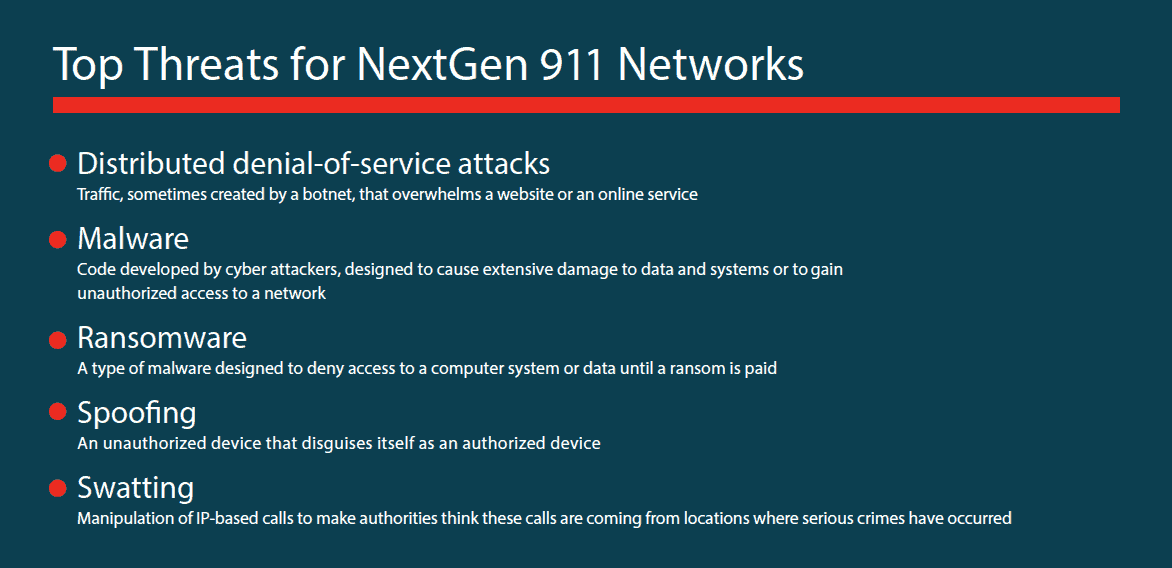
Security risks include denial of service attacks, malware, ransomware, spoofing, and swatting that can overrun the service provider or infrastructure. By securing Message Session Relay Protocol (MSRP) messages, agencies can make their systems more secure and reduce the likelihood that a denial of service, malware, or other cyberattacks occurs. 

Below are the top 4 things you can do to protect against these attacks:

  1. Perform security inspections on MSRP messages before entering in these systems 
  2. Limit the rate of messages as automated solutions can generate signals much faster than a human can type, which can overwhelm NextGen 911 systems and block emergency calls
  3. Implement Denial of Service (DoS) attack prevention software
  4. Implement privileged access management (PAM) software and policies to limit the potential damage from a security breach

Cybersecurity is essential to public safety and ensuring that NextGen 911 system.  To learn more download the infographic.


Montra Solutions Ranked Among World’s Most Elite 501 Managed Service Providers

Annual MSP 501 Identifies Best-in-Class Global MSP Businesses & Leading Trends in Managed Services

ATLANTA — (August 2, 2020) — Montra Solutions has been named as one of the world’s premier managed service providers on the prestigious 2020 annual Channel Futures MSP 501 rankings.

For the 13th year running, MSPs from around the globe completed an exhaustive survey and application this spring to self-report product offerings, annual total and recurring revenues, profits, revenue mix, growth opportunities, and company and customer demographic information. Applicants are ranked on a unique methodology that weights revenue figures according to long-term health and viability; commitment to recurring revenue; and operational efficiency.

Channel Futures is pleased to name Montra Solutions as number 299 on the 2020 MSP 501 list.

“We are pleased to be included in this prestigious list. It is a great confirmation that the work our team has done to serve our customers. Montra is providing unique and much-needed software innovation to the managed service industry,” said Scott Ryan, CEO, Montra Solutions. “And we are excited to bring this innovation exclusively to our customers to manage their IT operations better.”

In the 13 years since its inception, the MSP 501 has evolved from a competitive ranking list into a vibrant group of service providers, vendors, distributors, consultants and industry analysts working together to define the growing managed service opportunity.

“For the third year running, the applicant pool for the annual MSP 501 has grown year-over-year, making this year’s list the most competitive in the survey’s history,” says Kris Blackmon, Senior Content Director at Channel Partners and Channel Futures. “The MSP 501 leveraged judgment methodology brand-new in 2020 to drill down into not just what makes a big managed service provider, but what makes a great managed service provider. The 2020 winners are truly the best examples of innovation, business acumen, and strategic savvy on the planet. We extend our heartfelt congratulations to the 2020 winners and gratitude to the thousands of MSPs that have contributed to the continuing growth and success of both the 501 and the thriving managed services sector.”

Ten MSP 501 special award winners will be recognized at the MSP 501 Awards Gala at Channel Partners Virtual: Digital Events for the Modern Channel on September 8 – 10. Nominations for these special awards, including Digital Innovator of the Year, Executive of the Year and the Newcomer Award, were included in the MSP 501 application, and all candidates were encouraged to submit for them.

The data collected by the annual MSP 501 program drives Channel Partners’s and Channel Futures’ market intelligence insights, creating robust data sets and data-based trend reports that support our editorial coverage, event programming, community and networking strategies, and educational offerings. It serves as a lynchpin to dozens of programs and initiatives.

The complete 2020 MSP 501 list is available at Channel Futures.

Background

The 2020 MSP 501 list is based on data collected by Channel Futures and its sister site, Channel Partners. Data was collected online from Mar. 1 through June 30, 2020. The MSP 501 list recognizes top managed service providers based on metrics including recurring revenue, profit margin, and other factors.

About Montra Solutions

Montra Solutions is a managed IT services provider that has developed modern software to deliver enterprise-grade services to businesses of any size. Montra simplifies the management of increasingly complex IT operations with software that better integrates and automates the security and management of modern systems and data within the cloud, at the edge, or wherever your business takes you. Montra’s innovations are enabling scalability and consolidation for the highly fragmented, multi-billion-dollar managed services industry. Montra is based in Atlanta with offices in Tampa and Seattle and customers worldwide. For more information: www.montra.io.

About Informa Tech

Channel Futures, Channel Partners Online, Channel Partners Conference & Expo and Channel Partners Evolution are part of Informa Tech, a market-leading B2B information provider with depth and specialization in the Information and Communications (ICT) Technology sector. We help drive the future by inspiring the Technology community to design, build, and run a better digital world through our market-leading research, media, training, and event brands. Every year, we welcome 7,400+ subscribers to our research, more than 3.8 million unique visitors a month to our digital communities, 18,200+ students to our training programs, and 225,000 delegates to our events.


MEDIA CONTACT:

Kelly Bryant
Head of Product Management and Marketing
Montra Solutions
kelly.bryant@montra.io


4 Tips for Ensuring Compliance in the Cloud in 2020

Cloud Computing is well understood as a great method for increasing the speed of deployment and agility of managing IT infrastructure. For these reasons, the migration to and utilization of Cloud Computing continues to grow in both large enterprises and small businesses. However, this move towards increased use of the cloud – especially public cloud services – has increased the pressure for greater data protection regulations across the globe.

Unless you work for a very large organization that can cost justify developing and maintaining a private cloud infrastructure, utilizing Cloud technologies will mean relying on one or more public Cloud Service Providers (CSPs).39percent-of-IT-Decision-Makers-Consider-Themselves-Responsible

Recent high-profile data breaches have brought the risks associated with storing personally identifiable information (PII) into the limelight (i.e., the 2017 Equifax breach, the 2019 CapitalOne breach). Yet, the question of who is ultimately responsible for regulatory compliance remains a significant area of confusion. According to a recent study, only 39 percent of IT decision-makers considered themselves responsible for the compliance of data stored on cloud services. This is an incredibly dangerous mindset to possess, as by law, the ultimate responsibility for regulatory compliance remains firmly in the hands of the data owner – not the CSP.

Which Compliance Regulations Matter in the Cloud

The cybersecurity and data privacy compliance regulations that affect your company are dependent upon the industries in which you operate. Examples include federal government (FedRAMP), manufacturing (GMP), healthcare (HIPAA), real estate (CFPB), and financial services (FINRA, NYDFS). So, which regulatory requirements do you have to worry about in the cloud? The simple answer is the same ones that apply to your business already. Depending on your company’s industry, geographic location, and business function, this could be a range of compliance regulations, including:

  • National Institute of Standards and Technology (NIST)
  • General Data Protection Regulation (GDPR)
  • California Consumer Privacy Act (CCPA)
  • Health Insurance Portability and Accountability Act (HIPAA)
  • Financial Industry Regulatory Authority (FINRA)
  • Payment Card Industry Data Security Standard (PCI-DSS)
  • Federal Information Security Management Act (FISMA)
  • Sarbanes-Oxley Act of 2002 (SOX)

It is important to understand how your data and processes within your cloud service are affected by all of the applicable regulations, including data storage and retention policies, user access and password policies, and Most of these compliance frameworks require periodic testing of your IT operations, as well as ongoing monitoring to ensure constant It is important to understand the requirements While the responsibility for maintaining compliance lies solely within your organization, you don’t have to take on this burden completely alone. The good news here is that a consultant or managed IT services provider can guide you through the compliance challenges to meet the necessary laws and regulations.

When it comes to ensuring that your cloud operations will be in compliance with the regulatory requirements of your business, here are a few key tips…’

4 Tips for Ensuring Compliance in the Cloud

1. Realize a Compliant Provider Will Not Make You Automatically Compliant

Depending on which regulation you are subject to, you may be required to use a cloud service provider that is certified with those regulations. But it is important to note that using a compliant provider does not in and of itself make your business compliant automatically. You still have to use the service in a compliant manner; it is your responsibility to ensure the provider maintains regulatory controls on an ongoing basis. And you still have to maintain compliance for your own IT operations which connect to the cloud service provider.

2. Know Where Your Data Will be Stored

Some compliance regulations have geographic restrictions on where certain types of data can be stored and processed. For example, the European Union Data Protection Directive requires personal data to remain within the borders of the EU or a third-party country that offers adequate protection based on their previously defined security standards. This can pose a very large challenge if your CSP operates data centers and stores your data around the world. There is good news here: being aware of this caveat is a large part of the battle. All reputable cloud service providers are aware of this issue and offer geographical nodes that customers can select for their data to reside in as a part of their service offering.

3. Understand Access Control

A large portion of regulatory IT compliance stems from ensuring proper controls are in place over who has access to what data in the system. During a compliance audit, you must be able to prove the level of access that each user has and how those various levels are maintained. Your CSP must be able to provide you with documentation outlining how the implement separation of duties for administrative functions. They must also be able to provide clear documentation showing which users had access to which systems when, and what data and systems were able to be accessed by each user.

4. Know Your Service Level Agreement (SLA)

Regardless of what compliance regulations you are subjected to, don’t assume your CSP’s terms and conditions will satisfy your requirements alone. You should know the details and fine print of your cloud services contract inside and out. Again – the sole responsibility of compliance in the cloud is ultimately up to you, not your provider. Your SLA should be very clear on roles and responsibilities, incidence response execution, and data breach remediation. Everything in the SLA must be in accordance with the regulations governing your business. The finer points of an SLA are able to be negotiated with the service provider before signing. Just don’t wait until you have signed to realize that all your bases are not covered.

The good news about ensuring compliance within your Cloud environment is that legitimate service providers will be able to provide the right service for you to meet your governing regulations. That said, you need to know how to apply the regulations properly to how you are using the cloud service. If you are concerned about your regulatory compliance in the cloud services you are using, we recommend bringing in a 3rd party IT service provider, such as Montra.

Montra’s cloud experts can examine your current cloud operations, navigate you through the best options for establishing full compliance, as well as monitoring your compliance over time.

For more information about how Montra can help with your cloud compliance, contact us today.


10 Ways to Stay Safe As We Return to Work

In the last week or so the national conversation has shifted from sheltering in place to returning to work. Slowly and carefully, but we are opening back up. Now is the time to remain vigilant to the constant threats to your business from ransomware and malicious attacks.

In a recent article, Google stated that since January it has seen a 350% increase in phishing attacks, and they saw more than 18 million daily malware and phishing emails related to COVID-19 scams just in the past week. That’s on top of the more than 240 million daily spam messages it sees related to the novel coronavirus.

And it is not just companies that are getting overwhelmed. According to their own report, the FBI fielded 2,047 ransomware complaints in the U.S. in 2019. In response the crushing load of root cause investigations, the FBI has turned to corporate leaders and cybersecurity insurance carriers to better understand how to stop ransomware attacks.

The best course of action, is to proactively protect your organization from being attacked successfully. Making certain of that is a complex problem that is specific to each company, but we have created some quick tips to help you remember how to keep cybercriminals out of your IT operation.

10 Tips to Keep Cybercriminals Out

  1. Get the Facts. Stay away from the rumor mill and use information from reliable sources to make business decisions in chaotic times.
  2. Think Twice before Clicking Links. Make sure staffers are on the lookout for suspicious links that can lead to ransomware.
  3. Be Suspicious of Unexpected Attachments. Ensure users only open attachments from proven, trusted sources no matter how “official” that attachment looks.
  4. Automate Compliance. Have one less thing to worry about by choosing a dynamic web portal system that keeps track of everything.
  5. Protect those Passwords. Encourage safe password practices like using a password manager and not writing them on sticky notes.
  6. Beware of Strange Networks. Make staffers aware of the dangers of logging in from insecure public and home WiFi networks andhow to use them safely.
  7. Use Two-factor Authentication. An extra layer of security keeps passwords and data safe.
  8. Keep an Eye on the Bad Guys. Monitor the Dark Web to watch for company data so a problem can be addressed before it becomes a crisis.
  9. Stay Current on Threats. Work with a responsive partner that’s on top of today’s challenges.
  10. Ask for Help. Consult a security expert to plan effective strategies and get innovative solutions.

10 Tips to Keep Cybercriminals Out

So, while we seek continued improvements in our collective situations both professional and personal, continue to keep your guard up against ransomware and malicious attacks on your IT operation.

If you would like to learn more about how Montra can help you with these or other security threats, please contact us at info@montra.io.