
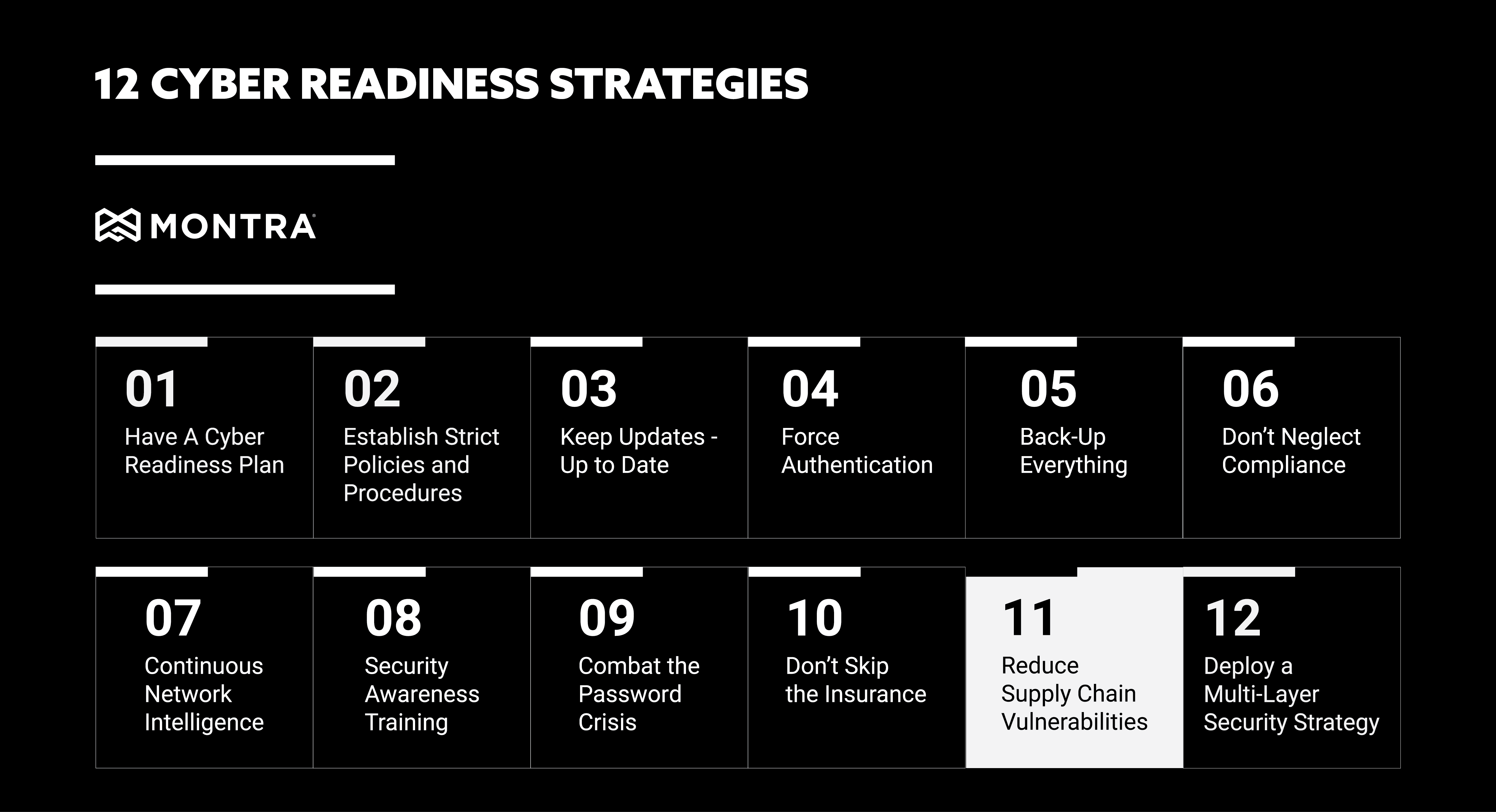
Cyber-readiness Strategy 11: Reduce Supply Chain Vulnerabilities

Nearly two-thirds of firms (65%) have experienced cyber-related issues in their supply chain in the past year. As a part of your cyber readiness plan, you must deploy protocols to evaluate and monitor the security of your supplier networks and third-party vendors.

The supply chain is only as strong as its weakest link, and with the increasing complexity of global supply chains, that weak link is becoming increasingly difficult to find and fix. Cybersecurity threats can come from anywhere in the world, and they can have a devastating impact on businesses of all sizes. That’s why it’s so important to include reducing supply chain vulnerabilities into your cyber-readiness plan. By taking steps to secure your supply chain, you can help protect your business from the devastating effects of a cyberattack.
Here are 7 ways to reduce your supply chain cybersecurity vulnerabilities:

1.     Understand Your Supply Chain

To reduce supply chain cybersecurity vulnerabilities, it is important to first understand your supply chain fully. By understanding the different components of your supply chain, you can better identify potential cyber risks and take steps to mitigate them. Make sure to conduct a thorough analysis of your supply chain including all your upstream and downstream partners, so that you can identify any potential weak points throughout the chain.

2.     Train Your Employees

This first place to start reducing your supply chain cybersecurity vulnerabilities is to train your employees. Employees should be trained on how to identify potential risks and how to mitigate them. They should also be aware of the different security controls that you have in place. By educating your employees, you can help reduce the risk of supply chain disruptions and keep your business running smoothly. If you are not comfortable doing this in-house, look for a third-party that has expertise in cyber-security training especially with supply chain in mind.

3.     Educate Your Suppliers

Another important step in reducing supply chain cybersecurity vulnerabilities is to educate your suppliers. Suppliers should be made aware of the different security controls that you have in place. They should also be trained on how to identify potential risks and how to mitigate them. You should look at cyber-security standards like NIST 800-161 and ISO 28000:2022, so that you have a common language and set of standards to use in your discussions with your suppliers.

By educating your suppliers, you can help reduce the risk of supply chain disruptions and keep your business running smoothly.

4.     Conduct Risk Assessments

Another important step in reducing supply chain cybersecurity vulnerabilities is to conduct risk assessments. By identifying potential risks, you can take steps to mitigate them. Risk assessments should be conducted on a regular basis – usually annually or semi-annually – so that you can keep up-to-date on the latest threats even as your supply chain changes. Risk assessments can be conducted with in-house personnel, but third-parties are often used to make certain that ‘new eyes’ a looking at the supply chain systems periodically.

5.     Implement Security Controls

Once you have identified potential risks, you can then take steps to mitigate them by implementing security controls. There are a variety of different security controls that you can implement, depending on the specific needs of your organization’s supply chain.

For instance, if you are moving computers or other smart devices through your supply chain, you need to take into consideration the patching and updating of those systems if they have been sitting in inventory for a long time. You should also consider the proper handling of those systems if they are returned for repairs. The systems should be air-locked until it is determined that they are not a risk to your organization.

6.     Have an Incident Response Plan

In the event of a supply chain disruption, it is important to have an incident response plan in place. This plan should include steps that you will take to mitigate the impact of the disruption. It should also include a list of contacts that you will need to contact in the event of a disruption. A complete Incident Response Plan will cover all aspects of your operation, not just your supply chain, but the supply chain has historically been left out of security planning. As modern supply chains become heavily digitized and as the items in the supply chain increasingly have software components to them, the Incident Response Plan needs to take the supply chain into account.

7.     Use a Cyber-aware Third Party Logistics Provider

If you are not sure how to reduce supply chain cybersecurity vulnerabilities, you may want to consider getting help from a third party logistics provider. A third party logistics provider can help you with a variety of different aspects of your supply chain. They can help you conduct risk assessments, implement security controls, and train your employees. By getting help from a third party logistics provider, you can effectively reduce supply chain cybersecurity vulnerabilities.

Now that you know more about how to reduce supply chain cybersecurity vulnerabilities, you can take steps to protect your business. By taking these steps, you can help reduce the impact of a supply chain disruption and keep your business running smoothly. Cybersecurity is an important issue in the supply chain that should be given the attention it needs. By taking a proactive approach, you can help reduce the risk of supply chain disruptions and keep your business running smoothly.

If you are not sure how to start assessing or remediating your supply chain cybersecurity vulnerabilities, you may want to consider getting help from a security-aware third party logistics provider. By working with a third-party logistics provider that has strong cyber-security skills, you can have confidence that you can effectively reduce your supply chain cybersecurity vulnerabilities.

If you have any questions or would like more information about reducing supply chain cybersecurity vulnerabilities, please contact us. We would be happy to help you protect your business from the many threats that exist in today’s digitized supply chain. If you would like more information or have questions about how strong your cyber-readiness is, please contact Montra at sales@montra.io.

Montra Ranked on Channel Futures 2022 MSP 501

Montra Ranked on Channel Futures 2022 MSP 501—Tech Industry’s Most Prestigious List of Managed Service Providers Worldwide

Annual MSP 501 Identifies Industry’s Best-in-Class Businesses Growing Via Recurring Revenue and Innovation

Montra has been named as one of the world’s premier managed service providers in the prestigious 2022 Channel Futures MSP 501 rankings.

Montra has been selected as one of the technology industry’s top-performing providers of managed services by the editors of Channel Futures. For the past 16 years, managed service providers (MSPs) from around the globe have submitted applications to be included on this prestigious and definitive listing. The Channel Futures MSP 501 survey examines organizational performance based on annual sales, recurring revenue, profit margins, revenue mix, growth opportunities, innovation, technology solutions supported, and company and customer demographics.

MSPs that qualify for the list must pass a rigorous review conducted by the research team and editors of Channel Futures. It ranks applicants using a unique methodology that weighs financial performance according to long-term health and viability, commitment to recurring revenue and operational efficiency.

Channel Futures is pleased to name Montra to the 2022 MSP 501.

“We are honored to be included again in this prestigious list,” said Scott Ryan, CEO, Montra. “We have great customers that we love to serve and that makes awards like these possible for us.”

This year’s list once again attracted a record number of applicants, making it one of the most competitive in the survey’s history. Winners are being recognized on the Channel Futures website and will be honored at a special ceremony at the Channel Futures MSP Summit + Channel Partners Leadership Summit, Sept. 13-16, in Orlando, Florida.

Since its inception, the MSP 501 has evolved from a competitive ranking into a vibrant group of innovators focused on high levels of customer satisfaction at small, medium and large organizations in public and private sectors. Today, many of their services and technology offerings focus on growing customer needs in the areas of cloud, security, collaboration and support of hybrid work forces.

“The 2022 Channel Futures MSP 501 winners are the highest-performing and most innovative IT providers in the industry today,” said Allison Francis, senior news editor for Channel Futures. “The 501 has truly evolved with the MSP market, as showcased by this year’s crop of winners. This is also the fifth consecutive year of application pool growth, making this year’s list one of the best on record.”

“We extend our heartfelt congratulations to the 2022 winners, and gratitude to the thousands of MSPs that have contributed to the continuing growth and success of the managed services sector,” said Kelly Danziger, general manager of Informa Tech Channels. “These providers are most certainly driving a new wave of innovation in the industry and are demonstrating a commitment to moving the MSP and entire channel forward.”

The complete 2022 MSP 501 list will be available on Channel Futures’ website on Monday, June 20th.

Background

The 2022 MSP 501 list is based on confidential data collected and analyzed by the Channel Futures editorial and research teams. Data was collected online from Feb. 1-April 30, 2022. The MSP 501 list recognizes top managed service providers based on metrics including recurring revenue, profit margin and other factors.

About Montra

Montra® helps companies manage and secure their increasing range of device and workforce locations with software and services designed to support rapidly expanding business operations.

Cloud and mobile technologies have freed workforces to be productive from almost anywhere, but it is has made security and reliability far more difficult. Additionally, increased security threats and changing compliance standards are requiring new techniques and skills to defend and comply. Montra simplifies the complexity of managing and securing hybrid workforces and devices of all types – saving you time and making you more secure.

Montra delivers an integrated software and service offering that provides enterprise-grade IT service management to businesses of any size. Our software, Montra VIA, automates some of the most common technology processes in your business including employee onboarding, offboarding, identity management, device monitoring, device procurement, device deployments and device upgrades and repairs.

Let Montra enhance your technology-enabled operation with software and services that seamlessly protect your devices and workforce – in the cloud, at the edge, or wherever your business takes you. Montra is headquartered in Atlanta with customers worldwide.

To learn more about how Montra can help manage your technology operations, contact us at info@montra.io or www.montra.io/contact-us.

About Channel Futures

Channel Futures is a media and events platform serving companies in the information and communication technologies (ICT) channel industry with insights, industry analysis, peer engagement, business information and in-person events. We provide information, perspective, and connection for the entire channel ecosystem. This community includes technology and communications consultants, integrators, sellers, MSPs, agents, vendors and providers.

Our properties include the Channel Futures MSP 501, a list of the most influential and fastest-growing providers of managed services in the technology industry; Channel Partners events, which delivers unparalleled in-person events including Channel Partners Conference & Expo, the MSP 501 Summit and Channel Partners Europe; and Allies of the Channel Council (ACC) and DEI Community Group, our initiatives to educate, support and promote diversity, equity and inclusion (DE&I) in the ICT channel industry. Channel Futures is where the world meets the channel; we are leading Channel Partners forward. More information is available at channelfutures.com.

Channel Futures is part of Informa Tech, a market-leading B2B information provider with depth and specialization in ICT sector. Every year, we welcome 14,000+ subscribers to our research, more than 4 million unique monthly visitors to our digital communities, 18,200+ students to our training programs and 225,000 delegates to our events.

Media Contacts

Monty Rachleff

Marketing Coordinator, Montra

marketing@montra.io


Allison Francis

Senior News Editor, Channel Futures and MSP 501

allison.francis@informa.com

Ginette Andre

Associate Marketer, VIP Relations

ginette.andre@informa.com

Benefits of Microsoft 365 and Azure Active Directory for Identity Management

Identity management is critical for businesses today. In a world where more and more employees are working remotely and accessing corporate data from a variety of devices, it’s important to have a robust system in place to manage and protect employee identities. That’s where Microsoft 365 and Azure Active Directory come in.

When used together, Microsoft 365 and Azure Active Directory provide a complete solution for identity management in organizations. Microsoft 365 provides the productivity and collaboration tools that users need, while Azure Active Directory handles the single sign-on and security features. This offers several benefits, including a consistent experience for users across all applications, enhanced security through centralized control.

Azure Active Directory

Azure Active Directory is a cloud-based identity management service that provides single sign-on (SSO) capabilities and robust security features. It offers several capabilities, including an enterprise identity service that provides single sign-on, multifactor authentication, and conditional access.

Microsoft 365

Microsoft 365 is a cloud-based productivity and collaboration suite that is the most popular SaaS platform in use today. It includes the Microsoft Office applications, Outlook, OneDrive, SharePoint, and Teams. It offers several capabilities, including email, calendaring, contacts, tasks, and document management.

Using Microsoft 365 and Azure Active Directory for identity management provides several benefits:

1. Centralized Management of Workforce Identities

Organizations that use Microsoft 365 and Azure Active Directory can manage their workforce identities in a centralized way. This means that they can provide their employees with a single set of credentials to access all the applications and services that they need, both on-premises and in the cloud. This makes it much easier for administrators to manage user accounts and reduces the chances of users forgetting their passwords or having their accounts hacked.

2. Consistent User Experience across Applications

When users sign into Microsoft 365 with their Azure Active Directory credentials, they will have the same experience across all the applications that they use. This includes the Office applications, Outlook, OneDrive, SharePoint, and Teams. They will also be able to access their files and documents from any device, including their mobile phones.

This makes it easier for users to access the information and resources they need, regardless of which application they are using. Additionally, it reduces the need for training on multiple applications.

3. Enhanced Security through Centralized Access Control

Azure Active Directory provides organizations with the ability to control access to their applications and resources in a centralized way. This includes the ability to set up multifactor authentication and conditional access rules, making it easier to monitor and control access to resources.

This enhanced security helps to protect corporate data and makes it more difficult for hackers to gain access to sensitive information. Additionally, it reduces the chances of users accidentally disclosing corporate data.

4. Reduced IT Costs and Increased Efficiency

M365 and Azure AD offer reduced IT costs and increased efficiency by enabling organizations to manage all identities in one place. This is because administrators can manage users in a centralized way, eliminating the need to maintain multiple user accounts across different applications. This makes it easier to provision and deprovision users, as well as to monitor and control access to resources.

Additionally, Azure Active Directory integrates with the Microsoft 365 suite of products, making it easier to deploy and manage. This integration can help to reduce the amount of time and effort required to manage user accounts.

Microsoft 365 and Azure Active Directory are a valuable combination to give organizations of any size the ability to manage identities. While the capabilities provided are great, the ability to cost-effectively leverage these capabilities can be beyond the scope of even the largest IT organizations.

At Montra, we understand the importance of workforce identity management and security, which is why we have spent time developing our own software that leverages the core capabilities of M365 and Azure AD to ease the use of it for all IT organizations. If you have any questions about our identity management services and software, please contact us at sales@montra.io.

The Top 5 Benefits of Azure Active Directory

Are you looking for a comprehensive identity management solution? If so, Azure Active Directory (Azure AD) may be the perfect option for you. Azure AD is a cloud-based service that provides identity and access management for your business. It offers a variety of features and benefits that can help improve security, simplify management, and reduce costs. Azure AD is the technology that allows organizations to connect their on-premises Active Directory to Azure to provide a single sign-on (SSO) experience for their users. 

There are many benefits of using Azure AD, but in this blog post, we will focus on what we see as the top 5 benefits:

1. Increased security and compliance

With Azure AD, you can implement robust security measures to protect your data and meet compliance requirements. Azure AD provides features such as multi-factor authentication and conditional access that can help you secure your data and comply with industry regulations. 

Azure AD can also help you meet your compliance needs by providing comprehensive reporting and auditing capabilities. You can use Azure AD to: 

  • Enforce strong authentication policies 
  • Restrict access to sensitive data 
  • Monitor user activity 
  • Generate reports on user activity 

Azure AD can be used to secure on-premises applications and resources, as well as cloud-based applications and resources. These features can help you keep your data safe and comply with industry regulations.

2. Single Sign-On (SSO) and multi-factor authentication (MFA)

Azure AD helps improve security by providing Single Sign-On (SSO) and multi-factor authentication (MFA) – making it easy to manage user identities and access control. SSO allows users to access all their applications with one set of credentials. This can help improve security by reducing the number of passwords that users must remember. MFA provides an additional layer of security by requiring users to confirm their identity with a second factor, such as a phone call or text message. 

Azure AD also enables administrators to manage user identities and roles, as well as configure security settings for their organizations. Azure AD offers a variety of security features, such as password policies and activity monitoring, that can help you keep your users and your data safe.

3. Central Management of Applications and Users

Azure AD can simplify management by providing a central location to manage all your users and applications. You can use Azure AD to create and manage user accounts, assign permissions, and control access to applications. Azure AD also provides a self-service password reset feature that can help reduce IT support costs since password resets are the number one help desk request.

4. Reduced costs

Azure AD is a cost-effective solution that helps organizations save time and money by simplifying your IT infrastructure. Azure AD is its pay-as-you-go pricing model. With this pricing model, you only pay for what you use, which can be a great way to save money on your Azure AD deployment. 

Azure AD also reduces cost by eliminating the need for on-premises infrastructure. This can help save you money on licensing as well as support since cloud-based services are more cost-effective for third parties to support for you.

5. Increased flexibility and scalability

Azure AD is a cloud-based service. This makes Azure AD highly scalable, so it is easy to grow your user base as your business needs change. It also means if your company is moving more toward hybrid work, then Azure AD services will be delivered to your users with great performance no matter where they may be. No need to manage a complex virtual private network (VPN) to get users onto the same network as the on-premises AD instance. 

Azure Active Directory is a comprehensive identity, application, and resource management solution that offers broad features and benefits. If you are looking for an identity management solution that is well-proven and has connectivity to a broad range of applications and services, Azure AD may be the right option for you. 

While powerful, Azure AD is still a bit unapproachable by most users. This is where our team of experts at Montra can help. We offer a variety of software and services, including our own software, Montra VIA, which leverages Azure AD to provide easy to leverage workforce and application management capabilities to companies of any size. Email us at sales@montra.io to learn more about how we can help you with your identity management needs. 

Laptop Security Best Practices

Laptops are a valuable asset for the workforce of companies of any size. They allow employees to stay connected while on the go and can are critical tools to accomplish work quickly and effectively. When work laptops contain important data and client information, it’s essential to take measures to keep them secure. Below are some of the essential steps you can take to protect your laptop from theft and keep your data safe.

Physical Security 

Laptop security begins with physical security. Always keep your laptop in a safe place when you’re not using it. If you’re carrying it with you, make sure it’s in a secure bag that thieves can’t easily access. When traveling, never leave your laptop unattended in a public space, and make sure to always keep it with you. 

System Password

It’s also important to protect your laptop with a strong system password. Use a combination of letters, numbers, and symbols to create a password that would be difficult for someone to guess. Avoid using easily guessed words like “password” or your name. You should also change your password periodically to further reduce the risk of it being guessed with a brute force approach. 

Security Software 

In addition to physical protection and local access protection, it’s essential to take steps to protect yourself when you connect your laptop to the Internet. Be sure to install cybersecurity software on your laptop and keep it up to date. The most sophisticated software is called endpoint detect & respond (EDR). The best EDR software will not only protect you from known viruses and ransomware attacks but will also detect odd behavior and respond to it immediately. 

Personal Awareness

Not all security can be handled purely by software smarts, people need to practice good cyber behaviors online to keep their system and their data safe. Avoid clicking on links or opening attachments from unknown sources, which can surreptitiously load malware or ransomware onto your laptop. When using public WiFi networks, be sure to use Virtual Private Network (VPN) software to encrypt all your activity. This prevents other lurking on the network from seeing your passwords and other private information on the network. 

Laptops are a valuable asset and a potentially weak link in your company’s security chain/ They should be protected with the best security practices. At Montra, we understand the importance of data security and have put measures in place to protect the information of our customers and their users. We offer have software and services to help you secure your laptops and other devices, secure your workforce’s identities, and secure your company’s data. If you have any questions about our security measures or how to protect your company’s laptops, please don’t hesitate to email us at sales@montra.io